This website is available in Hindi or English language



Roopkund Lake: Himalaya's mysterious skeleton lake
Introduction: Where beauty meets terror
The Indian Himalayas have a lake contrary to any other. Surrounded by ice -worn peaks, succulent alpine meadows, and breathtaking scenes, Roppund Lake in Uttarakhand is a destination that attracts trekkers, researchers and storytellers equally. Nevertheless, despite its beautiful beauty, the lake is from simple. At an altitude of more than 16,000 feet, this glacial water body hides a cold secret: hundreds of human skeletons are lying on its bottom and scattered with their banks.
This terrible discovery gave it a "skeletal lake" nickname, and since, when, Roopkund remains one of the greatest mysteries in India. Was these people a natural disaster, a fight, or something more frightening? Why are there remains for more than a thousand years? And why the lake is surrounded by strange stories of curses, souls and divine anger?
In this detailed article, we will detect every dimension from its geographical settings and trek roots to scientific studies, folklore, paranormal principles and travel tips. Whether you are a suspicion, a courageous, or lover of mysteries, the metaphor is bound to fascinate you.
Geography of Ruopakund Lake
Location: Roopkund is located in Chamoli district of Uttarakhand, India, in the lap of Trishul Masif of Himalayas.
Height: The lake sits about 5,029 meters above sea level (16,499 ft).
Size: Roopkund is small - only 40 meters in diameter - but its importance is much more than its size.
Accessibility: The lake is available only through a multi-day trek, making it a distant and challenging destination.
Roopkund's journey passes through dense oak and rhododendron forests, bizarre Himalayan villages, Bedney Bagyal such as alpine meadows and steep icy slopes. This mixture of natural beauty and foresight enhances the terrible aura of the lake.
Search for skeletons
In 1942, the cold truth about Roppund Lake was revealed when a forest ranger stumbled on hundreds of skeletons and floated in water and buried under snow. First, the authorities suspected that they belonged to Japanese soldiers who tried to invade British India during World War II. However, further studies showed that the skeletons were very old.
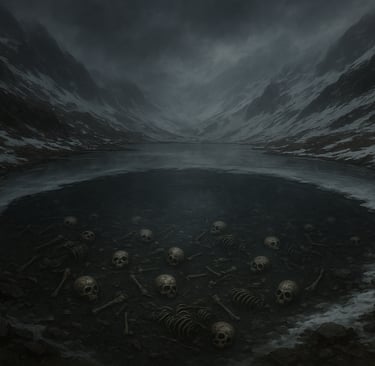
Surprised researchers had a sheer number of skeletons - more than 300 to 600 individuals - significantly well preserved in icy environment. Even today, when the ice melts during summer, trekkers can see bones, skulls and residues of ancient artifacts around the lake.
Skeletal theory
Over the years, many principles have tried to explain the origin of skeletons:
Army or attacking force
Some historians suggested that the skeletons belonged to a lost army or attacker soldiers who fell into the mountains.
Pilgrim disaster
Another theory connected the remains to a group of Hindu pilgrims traveling to the pilgrimage site of Nanda Devi. Travel became fatal due to weather or natural disaster.
Tribal conflict
Some anthropologists proposed that the group could be attacked by local tribes during their visit.
Hailstorm curse (most popular folk song)
The local folklore speaks of a divine curse. According to legend, King Jasdhawal of Kannauj once performed pilgrimage with his pregnant queen and servants. He angered Goddess Nanda Devi dancing and celebrating in her holy land. Annoyed, the goddess hit him with a hailstorm of rigid ice balls, killing them all immediately. The skeletons scattered around Roppund are believed to be considered the remains of that cursed group.
Scientific research and conclusions
Modern research has provided attractive insights:
Radiocarbon dating: Studies revealed that the skeletons belong to two different time periods - around a 9th century and around the CE of the 19th century.
DNA evidence: genetic analysis showed that the remains were not from the same community, but it included diverse ethnic groups - South Asian and even people similar to the Mediterranean origin.
Causes of death: Many skulls tolerate deep fractures according to the blunt force trauma. Scientists believe that suddenly, large -scale hailstorms caused these injuries to align with local folklore.
This combination of science and myth is one of the most rare archaeological riddles in the world.
Paranormal and horror legends
Beyond science, Roopkund's terrible reputation gives fuel to horror seekers:
Restless souls: Local people believe that the soul of those who died in the lake still wanders on the mountains. Passengers have insisted on crying, crying and footing near the lake at night.
Cursed ground: This region is still considered to be holy, with warnings against the goddess disrespecting the goddess.
Mysterious music: Some trackers claim that there is a claim to listen to unemployed music or chant in grasslands leading to the lake.
These stories convert Roopkund into a haunted Himalayan puzzle from a trekking destination.
Trek for Roopkund
For courageous people, the Roopkund trek is one of the most prestigious trips in India.
Major Highlights of Trek:
Lohajung - Early point, a small hill village.
Dina Village - A peaceful Hamlet with traditional Himalayan culture.
Ali Bugyal and Bedni Bugyal - Vishal Alpine Meadows is considered the most beautiful in Asia.
Patthar Nachauni - A camp was bound by legend of Dancing Kings Troop.
Bhagwabasa - Base Camp before final climb.
Roopkund Lake - Chilling Destination appears in the clums of clinging with skeletons.
Junargali pass (optional) - A steep climb moves forward and offers a spectacular view of Roopkund.
difficulty level:
The trek is moderately highly challenging, with steep ascending, unexpected weather and high height.
Best Time: May -June and September -October.
For trekkers, reaching Roppund is both a spiritual and terrible experience, as the beauty of the Himalayas struggles with the serious vision of human remains.
Cultural and religious importance
Roopkund Skeleton is closely associated with the worship of Goddess Nanda Devi. Every 12 years, Nanda Devi Raj Jat Yatra - A grand pilgrimage - passes through this region. Pilgrims believe that skeletons are a divine reminder of the power and anger of the Goddess.
Instead of being seen as only a horror site, the metaphor is also treated with reverence and fear.
Roopkund in global media
Roopkund has fascinated researchers, media houses and travelers worldwide:
National Geographic and BBC documentaries have covered their secrets.
It is often compared to other world Egamams such as Pompei (Italy) and ötzi the isamman (Austria).
Paranormal enthusiasts worldwide lie to Roopkund among the most haunted places in the Himalayas.
Horror appeal of skeleton lake
What makes Roopkund is so a combination of visible human remains, rigid natural settings and local supernatural legends. Unlike hidden haunted places, bones here are real and visible, which blur the line between archeology and horror.
For thrills, it is a destination that reminds us of natural beauty and human mortality.
Travel tips for courageous people
Permit: Required from forest officials.
Fitness: pronunciation at high-height is necessary.
Guide: It is highly recommended to hire local guides.
Honor: Do not disturb or collect skeletal remains; They are protected heritage.
Gear: There should be trekking shoes, layered fabrics, sleeping bags, and medical kits.
Conclusion: a frozen secret
Roopkund lake, with its Macabre skeleton and breathtaking settings, a reminder that Himalayas catch the mysteries that we can never open completely. Whether explained by science or wrapped in folklore, the skeleton lake remains a symbol of the power of nature, divine anger and the delicateness of human life.
This is a place where pilgrimage is scary, archaeological meth is found, and beauty is found by death. Even as research continues, Roopkund refused to leave all its secrets. And perhaps that's why it continues to woo the hearts around the world and to incite imaginations.